How to use this framework
This is a four-session workshop, run across ten stops, built directly on The Systems Intelligence Guide for K‑12 Educators. You score the three analyzers first, before any of the framework language. Then you learn the framework and work through the six diagnostic instruments. Then you score those same three analyzers again — and the difference between the two readings is the point of the whole exercise. Everything stays in your browser; you decide whether to release anything anonymously to the room.
It is not a diagnosis and not a motivational session. It is an awareness instrument: it identifies which system layer your pressure originates in, distinguishes structural compression from individual fragility, and ends with one printable recommendation carrying two commitments — one you can act on yourself, one that requires a design change from your institution. An AI interpreter reads your scores in four separate stages and drafts both.
Every model in this workshop rests on established research, cited on screen where it is used and listed in full under Reference and facilitator. The synthesis is the authors’; the foundations are not.
Information is the driver here. Educators carrying systemic pressure routinely read it as personal insufficiency, and that misreading is itself part of what deepens the strain. Seeing the whole picture — which layer the pressure originates in, how it circulates, which pillar it destabilises — changes the account a person gives of their own situation. That shift is not cosmetic: an accurate account lowers self-blame, restores agency, and makes the difference between a problem you endure and a problem you can act on. Often the awareness begins to resolve the deeper problem before any intervention is applied.
Sign in to run the workshop
This workshop is licensed. Sign in with the account created at purchase, or with the credentials issued to you by your administrator.
Twenty-five terms the whole room needs to understand the same way
This screen is where the underlying models are learned, one term at a time: five core words, the five concentric levels, the five pillars, the two loop nodes where the models overlap, the five burnout phases, and the three terms the whole framework exists to explain — burnout, student pushback and attrition. Twenty-five terms in all, each animated so the model behind it becomes visible. Each is shown four ways: watch it move, read it, do it yourself, then say it back, with six questions per term. Do not debate the definitions — align on them. Without shared language, structural thinking is impossible.
{{ lang.term }}
AI interpreter
Four stages, in order: your first reading alone, then each instrument alone, then the second reading with the measured impact of the framework language, then everything together — flowing into the recommendation. It reads only your scores and never sees a name.
Your recommendation sheet
Print or save as PDF. Vector text and rules — no screenshots — so it stays legible at any size and searchable in a file.

Educator Sustainability Recommendation
From where you are now to a recommendation you can act on
Ten stops, in order. Score the analyzers first, learn the framework, work the instruments, then score again — the difference is the point. A stop ticks only when it is actually finished.
{{ thread.rec.headline }}
Burnout Analyzer — Concentric Circles, Feedback Loop, Five Pillars
One hundred and fifty scored items across the three frameworks — fifty each, with the reversibility matrix and an integrated summary. Scores persist separately from the workshop instruments and feed the red thread.
Save your first reading
Answer the attribution check below, then save what the analyzers say about you now — before any of the framework vocabulary reaches you. Everything after this point is compared against it.
| Framework | First | Second | Change |
|---|---|---|---|
| {{ r.name }} | {{ r.first }} | {{ r.second }} | {{ r.delta }} |
Administration
| Capability | Super admin | Facilitator | Administrator | Educator |
|---|---|---|---|---|
| {{ m.cap }} | {{ m.owner }} | {{ m.facilitator }} | {{ m.admin }} | {{ m.educator }} |
Sign in to administration
Analytics, audience, SEO, team and roles, security, page content and the research layer. This gate is a front-end placeholder — connect it to your CMS session or Supabase auth before deployment.
Research layer
Exactly what is computed here, what has to be computed elsewhere, and the item-level export that makes the second possible. Nothing in this workshop is a fitted model — that is what a pilot changes.
| Dimension | n | Mean | SD | Alpha |
|---|---|---|---|---|
| {{ d.name }} | {{ d.n }} | {{ d.mean }} | {{ d.sd }} | {{ d.alpha }} |
application/json with a recorded consent flag. Set the URL in Tweaks; no keys are stored in this file.{{ research.jsonText }}
Research references
The sources behind every model, instrument and phase in this workshop, as published in The Systems Intelligence Guide for K‑12 Educators (WAFORD Press, 2026). Citations appear inline on the framework, shared-language and instrument screens.
{{ deck.title }}
{{ deck.purpose }}
{{ c.title }}
From coping to systems intelligence
Burnout is not a personal flaw. It is a systemic interaction effect. Across four sessions this workshop builds shared language, maps where compression actually originates, and closes with design commitments — not wellness statements.
Every instrument in the manuscript runs live here. Responses stay on this device; you choose when to release them anonymously into the room analytics.
{{ c.title }}
The Systems Intelligence Framework
Some school cultures are deliberate and long-lived, built over decades and defended on purpose. Others were never designed at all. They accumulated as leadership changed hands, as power and authority settled into new shapes, and hardened into “how things are done here” before anyone noticed a decision had been made.
The AI era has landed across a profession that spans generations in one corridor: the fluent, tech-native teacher and the deeply experienced colleague whose expertise was built in another medium, each measured against a standard neither chose. Beneath it sits institutional design — mandates, evaluation cycles, documentation, reward systems that quietly favour overextension.
Then the relational layer, where all of it is actually lived: between colleagues, between teacher and student, between school and family. Only then do we reach personality and mindset. Pressure converges toward the centre rather than starting there, which is precisely why the nervous system is mistaken for the cause.
How the models interlock
The five interaction levels, and how to tell them apart
Every facilitator card, every matrix column and every diagnostic question uses these five names. Learn the marker in the right-hand column — it is the fastest way to locate a case correctly.
Practice scenarios — work these cases to understand the rings
The Dynamic Feedback Loop
The rings explain where pressure originates. This model explains why it does not stay still. Compression circulates: institutional design raises load, load strains regulation, strained regulation reshapes identity, and a destabilised identity changes how the next directive is read — which feeds back into design. Nothing in the loop is anyone’s fault, and left unexamined it accelerates on its own.
This is the same compression, examined a second way. The concentric model asks where pressure comes from; the feedback loop asks how the parts hold each other in place. Its subject is interrelatedness: nervous system regulation, professional identity, cognitive and emotional load, the digital environment and institutional design are not five separate problems to be triaged in turn. They are one circuit. Strain in any one of them arrives at the others within days, which is why single-point fixes read as effective for a fortnight and then fail.
A reasonable mandate arrives. Documentation grows. Attention splits. Recovery shortens. Confidence thins while competence holds. Then a neutral directive lands as distrust — and leadership reads the slowdown as resistance. Each turn makes the next turn more likely.
The developmental path out runs Awareness, Interpretation, Regulation, Design, Sustainability. Awareness alone lowers escalation, because unnamed pressure defaults to self-blame. The question to make habitual: where in the circulation are we right now?
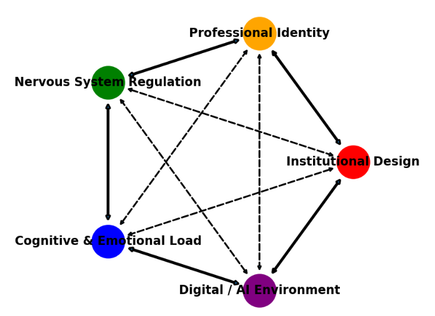
What circulates, and where to interrupt it
Practice scenarios — work these cases to understand the loop
The Five Pillar Growth Model
The five pillars are measured at every level of the concentric model — the same five rings you have just read, now used as the axis of measurement. Having established that the rings matter, and how pressure circulates through the feedback loop, we turn to what all of it acts upon: the five essential pillars that carry professional functioning. Sustainable functioning requires multi-dimensional stability, so each pillar is examined at all five levels of interaction. Burnout is rarely confined to one pillar — fragility increases when several destabilise across several levels.
A teacher can be mentally sharp and physically depleted, socially connected and spiritually adrift. Functioning does not fail when one dimension dips; it fails when several give way at once, quietly, in different directions. That is why a single measure of “wellbeing” tells a school almost nothing useful.
The same pillar behaves differently alone, with colleagues, under institutional design, under technological pressure, and under public narrative. A teacher steady on her own may destabilise the moment institutional visibility enters, which is not a character trait but a level effect.
Most growth tools measure traits and leave people where they were. This one measures direction: blame, overcontrol and collapse on one side; reflection, boundary, constructive assertion and leadership transition on the other. Agency is what stabilises identity under sustained pressure.
| Pillar ↓ / Level → | {{ l }} |
|---|---|
| {{ row.pillar }} | {{ c }} |
→ Reflection · Boundary · Constructive Assertion · Leadership Transition
Practice scenarios — work these cases to understand the pillars
Burnout Phase Matrix
Multi-pillar compression across progressive system strain. No educator sits fully in one column — pillars move at different rates, and that asymmetry is the diagnostic value.
There is rarely a single collapse. There is a sequence: strain absorbed, then compensated for, then absorbed into identity, then experienced as a violation of what the work was for, and finally answered by leaving. Naming the phase decides whether recovery is a matter of rest or of redesign.
Pillars move at different rates. Physical strain may sit in phase 2 while the spiritual pillar is already in phase 4, and outward performance often stays high throughout. The asymmetry is not noise in the data; it is the diagnostic signal, and it is what most instruments cannot see.
Early phases are highly reversible with recovery and workload adjustment. Moral fatigue is not exhaustion and does not respond to rest; withdrawal orientation is the band this framework classifies as high attrition risk. Offering breathing exercises at that point confirms that nothing structural will move.
| Pillar ↓ |
[{{ p.n }}] {{ p.name }}
|
|---|---|
| {{ row.pillar }} | {{ c }} |
Moral fatigue is not exhaustion.
Silence may indicate Phase 5.
Practice scenarios — work these cases to understand the phases
{{ inst.title }}
{{ inst.purpose }}
Phase Self-Placement
Privately place each pillar in the phase that best describes it right now. Pillars move at different rates — asymmetry is expected, and it is the point.
| Pillar | {{ p.short }} |
|---|---|
| {{ row.pillar }} |
Pushback Interpretation Exercise
Behavioural surface → nervous system → system meaning. For each behaviour, choose the reading you would act on. Not all resistance is defiance; repeated misinterpretation accelerates Phase 2 → Phase 4.
Your Systems Intelligence Profile
A developmental posture, not a performance rating. Nothing here leaves this device until you release it to the room.
Instrument Crosswalk
How each measured dimension translates into phase risk and the correct level of intervention. Your live scores are shown against each row so the room can see which pathway is actually active.
| Measured dimension | Your score | Phase alignment | Pillar at risk | Intervention level |
|---|---|---|---|---|
| {{ r.dim }} | {{ r.score }} | {{ r.phase }} | {{ r.pillar }} | {{ r.level }} |
Room Compression View
Anonymous clustering across {{ cohortCount }} released entries. Read clusters, never individuals.
| Pillar | {{ p.short }} |
|---|---|
| {{ row.pillar }} |
{{ c.label }}
|
Facilitator Guide
This workshop is not designed to diagnose individuals. It is designed to increase systems literacy. The goal is not emotional catharsis. The goal is structural clarity.